Manna Dey – Part 3
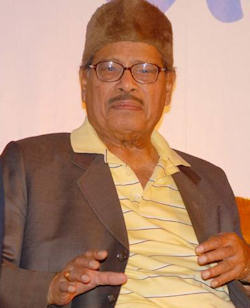
Manna Dey
It was the astute S.D. Burman, who discovered the comic side to Manna Da’s singing, enabling him to perhaps, atleast crack the limitations of the classical tag. In the 60′s, for Ziddi, Burman Da made Manna Dey sing the hugely popular and uproariously funny ‘Pyar ki aag mein, tan badan jal gaya’. Every Manna buff still remember the tragi – comic picturisation on Mehmood at the bereft shaadi ka mandap. And the comic interjections of veteran comedian Mukri as the irate father and Shubha Khote as the tragi – comic heroine.
Hugely, absurdly funny and all rendered by the so called ‘classical’ singer Manna Dey. If this is not versatility, nothing is.
Probably the only pairing, that brought another kind of recognition to Manna Dey was his voice over for Mehmood. From the mad ‘Pyar ki aag mein’ we move to the Beatles inspired ‘Aao twist karen’ from Bhoot Bangla in 1965. Here was rollicking, gyrating fun, completely antithetical to Manna Da’s image.
And that mother of all comic songs from Padosan. Much imitated, much enjoyed ‘Ek chatur naar’. Manna Dev voiced the South Indian music tutor played by Mehmood, while the truly comic Kishore Kumar, voiced the ganwaar lover Sunil Dutt. A total laugh riot this song is, always bringing on the chuckles whenever it is seen or played.
Manna Da never looked down upon his comedy songs. ‘I took utmost care over every song that I sang so that even today people want to listen to them’ he avers.
To Manna Da every song was like a child, to be nurtured, moulded, rendered with great care and affection. In 1979 he re-recorded eight of his most popular raga based numbers in stereophonic sound. As we listen to them, we come away with the feeling that even in their refurbished version not a single nuance is missing. No wonder then that veteran stickler composer Anil Biswas remarks ‘Manna Dey could sing whatever others could sing. But could they sing what he could?’
Colleagues of the Maestro, echo similar sentiments. All those gloriously romantic numbers alongwith, Lataji like `Soch ke yeh gagan jhoome’ in Jyoti; ‘Bheegi Chandni’ in Suhagan, ‘Tum gagan ke chandrama’ in Sati Savitri and the wonderfully catchy rustic tune ‘Chunri sambhal’ are rare, lustrousgems, which were the fruits of a pairing between two equals, Lataji concurs ‘These duets couldn’t have been sung by any other singer. The songs that Manna Da sang were his and his alone.’
Mahendra Kapoor is heard confessing that he was always scared when recording with Manna Da.
Even the fastidious and exacting composer C.Ramchandra could find no mistakes with the Maestro. Once in a duet recording with Rafi for a mythological film, the composer stopped to correct Mohd. Rafi but not Manna Dey.
His humanity always shone through. This man generous to a fault, would create improvisations in the song, for co-singers too, so that the overall rendition was always enhanced. Asha Bhosle would request an ornamentation for her rendition, while he created the same for himself, and he would do so on the spot. Their duets demonstrate this smooth compatibility, this effortless give and take of ideas. Especially in that finely crafted ‘Re man sur mein ga’ from Lal Patthar, composed by Shankar Jaikishan.
 ABOUT THIS AUTHOR
 Cineplot Cinema & Films
 Cineplot Photo Gallery
 Lata Mangeshkar – Part 3
 Shamshad Begum's Song List (1961 - 1970)
 Mohammad Rafi - Part 3
 Kishore Kumar's Song List (1946 - 1950)
 Talat Mahmood's Song List (1951 - 1955)
Reply