Shamshad Begum – Interview
____________________
Back to Legends – Shamshad Begum
____________________
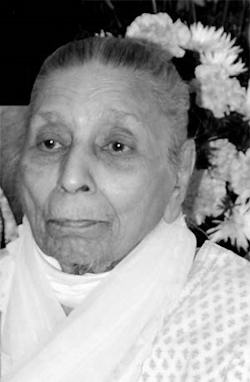
Shamshad Begum
Shamshad Begum, the undisputed melody queen of yesteryear, lives the life of a recluse today. This reclusiveness gives her an aura of mystery befitting her personality. She was, and remains, a reserved person. If she is known and loved today — six decades after she began singing — it is for her immortal voice and unforgettable songs like Piya ke ghar aaj pyari dulhaniya chali (Mother India), Kahin pe nigahen kahin pe nishaana (CID), Kahe koyal shor machaye re (Aag), O leke pehla pehla pyar (CID) and Ye duniya roop ki chor (Shabnam).
Born on April 19, 1919, Shamshad belonged to a large family of 12 children. She discovered her love for music early in life, but her conservative father didn’t encourage her to train in music. Fortunately, her uncle loved music and persuaded her father to send her for a music test which was being held by the popular music company Jenaphone. She was selected as the company’s artiste when she was just 13. Her first songs were non-film numbers which became so popular that she was invited to sing on the radio. For five years, Shamshad ruled the radio. When films did happen to her finally, she was already a known name.
“Most of what I sang in those days was non-film stuff because the talkies had just started in 1931 and not too many songs were incorporated in films in the first few years. I remember one song which became almost an anthem in those days — Ik baar phir kaho zara — but it didn’t belong to any film,” she smiles.
Lahore was then the hub of the film industry and Dalsukh Pancholi of Dalsukh Arts the biggest film-maker of the time. Playback singing had started in Bombay, but hadn’t yet reached Lahore. When it did, Shamshad Begum had the honour of becoming the very first playback artiste for Pancholi Arts. It opened the gates for a stream of successful films — Khazanchi, Khandaan, Pagli, Shukriya, Yamaljat. At times, even indifferent films did great business, partly because films were such a novelty and partly because of the music. And Shamshad was right at the top of the bracket. Even Lata Mangeshkar once told her, “No one has seen the kind of stardom and respect that you did!”
Her voice was unmistakable. Saawan ke nazare hain (Khazanchi) drove audiences crazy across the country. It was at this time that Shamshad was invited to Bombay. She refused to leave her beloved Lahore till Mehboob Khan personally requested her to. This was in 1942 for the film Taqdeer, which marked the Nargis’s debut. Shamshad came to Bombay, she sang and she conquered. Mehboob Khan signed her on to sing for most of his films.
But the times were difficult. The second World War was on and bureaucratic control overshadowed everything else. Shamshad had to return to Lahore, but not before Navyug Chitrapat, a Pune-based company booked her to sing. The film was Panna, another big hit.
While she was with Pancholi Arts in Lahore, its composer was Master Ghulam Haider. If anyone could claim to have taught Shamshad anything, it was Haider. He is the one who gave a professional touch to her singing. Haider had come to Bombay by this time. Shamshad too, finally decided to settle down here because most of the work was then concentrated in Bombay.
In 1943, K Asif made Phool and Shamshad was the lead playback singer in the film. Yet again, this film went on to become a big hit and reaffirmed Shamshad’s status as the reigning superstar.
Subsequently, she was considered to be the lucky mascot for every budding composer. Her spontaneous, open-throated style of singing brought alive each and every word of a song. All the composers approached her to lend her voice to their songs. She obliged, and often, for less than her usual fee because newcomers could not afford her.
Looking back, Shamshad says, “I really don’t know how I got into films. I had no training or encouragement at home. But I had been singing as far back as I can remember. When I joined school in Lahore, we used to sing a prayer before our classes started. All of us sang in chorus. One day the principal announced that there was one voice that stood out among the rest. It was me. I was made to stand on a school bench and lead the school prayer after that. It was my first public exposure.”
There was not a single big name she didn’t work for in Bombay. Leading music composers like Naushad Ali, Anil Biswas, Sajjad Hussain, C Ramchandra, Chitragupta, Shankar-Jaikishen snapped her up. She sang for practically most of Mehboob Khan’s films. Naushad got her to sing for as many as 19 super hit films. Who can forget the beautiful songs from Aan, Jadoo, Shahjehan, Anokhi Ada and so on? Chhod babul ka ghar (from Babul) remains the favourite bidaai song till today.
Shamshad sang for S D Burman’s hit Filmistan movie Shabnam. The song, Ek baar tou ban ja mera o pardesi catapulated him to the top rung of composers. He made Shamshad sing this song in 12 different ways symbolising the 12 months.
She had already sung in over 50 films before she came to Bombay, so she was always treated with awe. Says her daughter Usha, “Mummy was always very mature in dealing with people. There was nothing flighty or silly about her. She was also very principled. She never compromised on her work, never cancelled dates, never acted starry even at the peak of her career. She spoke formally to people, discussed her work and returned home. Throughout her career she remained an artiste, never did she become a businesswoman cultivating people in order to get work.”
The legendary singer talks about how music was made in those days. “Our songs were played and our producers earned money. Today, you have to pay to get your songs played. I’ll narrate an incident. When my songs became popular, Ghulam Haider got a hike in his payment. I hesitantly asked him to give me a hike as well. He told me to approach Pancholi. So I went to Pancholi. He greeted me politely and asked me to sit. When I told him what I had come for he immediately asked how much I wanted. I used to get Rs 100 for a song, so I asked for Rs 700. He agreed. I was thrilled. Then he said, ‘Even if you’d asked me for Rs 2000 even, I’d have agreed!’ I told him to give it to me, but he replied,
‘I’m a businessman first. I’ll pay you what you asked for.’ So that was that,” she recalls.
Shamshad became a legend very early in life and her generosity was even more legendary. Her magnanimity, non-assertive nature and professional approach earned her the fond nickname ‘appa’ in the film industry.
But unfortunately, Shamshad’s life became a series of generous gestures,to the extent that sometimes composers used her to get a platform before moving on to other singers. Madan Mohan, who had beseeched her to sing for his debut film Aankhen, turned to Lata Mangeshkar, O.P. Nayyar, who just couldn’t compose without her at one time (Aasman, CID, Aar Paar) focussed his attention on Asha Bhosle.
During this time, Shamshad’s faith in God stood her in good stead. It never occurred to her to cultivate composers or appoint agents to do her work. She maintained her dignity and her professionalism throughout her career, preferring to go into oblivion if destiny willed it for her. Today, she speaks with the dignity of one who has emerged stronger.
Encouragement was something she never had. Shamshad, herself a Muslim, married G L Batto, a Punjabi lawyer. “When I got married, my husband was just not the sort of man who would want his wife to sing but I made it a condition that I wouldn’t quit. Thereafter, he didn’t stop me, but when our daughter was born he was very strict with her. Though she too had a good voice, she was not allowed to train,” rues the mother.
Shamshad Begum has fond memories of her contemporaries — Zohrabai Ambalewali, Amirbai Karnataki, Begum Akhtar, Noor Jehan, Juthika Roy, Rajkumari. “When we were together, we were great friends,” she claims. “We had a pleasant relationship, though we didn’t socialize with each other after work. At least, I didn’t. But our professional association was good. We were all fans of K L Saigal. No one thought of harming the other, nor did we try to snatch work away from anyone.”
She also explains why singing was harder those days. “Each song had to be recorded twice — once for the film and once for the recording company. So even if you were working full time you could do only about four songs a day. Recordings took place in the evenings and shootings during the day. We worked in an atmosphere where composers put their soul into the compositions and the results are there to see — even today — isn’t it?” asks Shamshad.
During her heydays, Shamshad Begum was paid Rs 12.50 for a song by the recording company and Rs 100 by the producer for singing in the film, “but in those days, it was a lot of money,” she adds.
Does she have any regrets? “Yes,” says Shamshad, “My greatest regret is that I never got to sing with K L Saigal, though we did sing for the same film, Shahjehan. I was really shy of getting photographed. Once the two of us ran into each other at the recording company, but he didn’t know me because no one had seen my pictures. It was funny because we were then introduced and he said, ‘arre kudiye … tera bhala ho… tu kitna sona gaati hai… (God bless you, girl, you sing so well).’ Her eyes glint as she narrates this incident, recalling every nuance in the voice of her favorite singer. It also makes one realize the kind of talent these singers had and the respect they commanded from each other.
Ironically, each time Shamshad gave a hit song, she had to start all over again. All those composers who had once begged her to sing for them started giving her a raw deal. For instance, she recorded the song O leke pehla pehla pyar for CID which was, and remains, a popular song. After the recording, the sadder version was given to Asha Bhosle to sing, and this was publicized with great gusto. Despite that, it is Shamshad’s version that remains in the memory of listeners. But she read the sign loud and clear, and preferred to opt out of the messy situation, rather than stoop to stay in competition.
And in spite of life’s vagaries, she made everything that came to her a big success. Her songs gave the careers of several music directors a boost — Shaukat Dehalvi Naashad (Nagma), O.P. Nayyar (Aar Paar), Chitragupta (Sindbad Jahazi). Her number with Kishore Kumar, Mere neendo mein tum mere khwabon mein tum will perhaps
survive another century.
Shamshad still remembers her first impression of the young Kishore Kumar. Says she, “He was a fine boy, always full of life, but professionally low because he wasn’t reaching where his brother had. I remember telling him, ‘destiny is a great thing tomorrow you may become more popular than anybody else.’ And he actually did.”
Such was the demand for Shamshad Begum that film-makers waited for her to be free to sing for them. Tarachand Barjatya wanted her to come to Madras to sing for his film. But she couldn’t spare the time, so he came to Bombay. In his film Bahar, she sang Dil ka qarar leke aaja re aaja pardesiya and Duniya ko laat maro. Guru Dutt had a superb singer at home in Geeta Dutt, but if he decided that Shamshad had to sing a particular number, then he awaited her pleasure and
convenience.
That speaks for the talent and virtuosity of this singer, particularly when one sees how replaceable some others have been.
It was when people started playing games that Shamshad went into self-imposed oblivion. Today, she leads a retired life with memories of another day to keep her company. But she retains that regality which made her rule musicdom once – Lata Khubchandani
Interview has been edited for accuracy – Ummer Siddique
 ABOUT THIS AUTHOR
 Cineplot Cinema & Films
 Cineplot Photo Gallery
 Kishore Kumar's Song List (1956 - 1960)
 Munawwar Sultana
 Lata Mangeshkar - Madan Mohan Collaboration
 Suraiya - Khurshid Anwar Collaboration
 Album Review - Sara Jahaan by Karavan
(add)- One Comment
- Trackbacks/Pingbacks