Snehprabha Pradhan

Snehprabha Pradhan
Snehprabha Pradhan (actress, singer, screenplay writer, biographer) was very much part of the socialistic movie intelligentsia that roamed the planet in the ’30s and ’40s. Born around 1920s, she was the daughter Vitthalrao Pradhan and Tarabai.
Like her contemporaries (Shanta Apte etc), Snehaprabha spent a culturally diverse childhood. The first 10 years of her life took her to Nagpur, Bombay, Poona, Delhi, Calcutta, Lahore and other places. As the story goes, by the age of 18, she was already fluent in 4 languages. Her love for animals was legendary. Dogs and cats and birds were her best friends, and she longed for the day when she would be a doctor, no doubt to take care of humans and animals alike. Sadly, she never went past a couple of years of college.
It was probably around the late ’30s, that she got the first jolt of reality. Her father had left the family some years ago, and her mom Tarabai was taken ill, and could no longer support the family. Movies were the last thing on Snehprabha’s mind, but circumstances and good contacts i.e. Chimanbhai Desai of Bombay Talkies led to the first few assignments in films like Saubhagya (1940), Civil Marriage (1940), and Sajani (1940).
Thanks to Chimanbhai Desai, she got the first lead role of her career opposite Kishore Sahu in Bombay Talkies’ Punarmilan (1940) – music by Ramchandra Pal with possibly some orchestral guidance by Saraswati Devi. The most popular song of Snehaprabha’s music career was “naacho naacho pyaare man ke mor”. Punarmilan became the biggest hit of her film career and it also introduced her to Kishore Sahu. They met, fell in love, and tied the knot, but the marriage lasted about a year. In the early ’40s, there she was, fending for herself all over again. The divorce made the tabloids. She was upset, and talked about responsible journalism, but did not go any further.
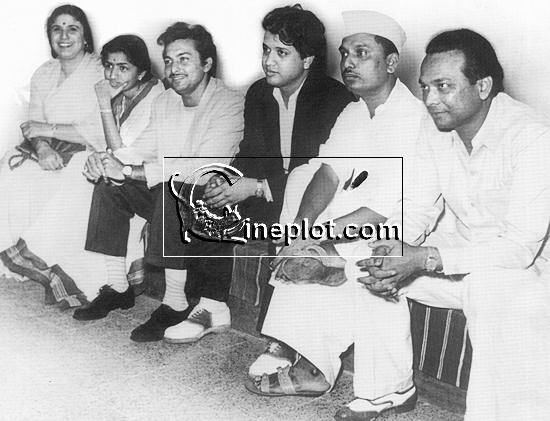
Also around this time, she connected with the Master Vinayak’s circle. Coincidentally, a 13-year old Lata Dinanath Mangeshkar was desperately looking for a job around 1942. A Vinayak colleague (R.S. Junnarkar) was in the process of making Paahili Mangalaagaur (1942), and Snehaprabha fitted right in as the leading lady opposite Shahu Modak. The movie is a landmark because it got an A certificate on account of a suggestive bedroom sequence (dark screen, hushed background sounds). People saw this movie over and over again, and some even carried strong flashlights into the theatre, hoping to get more out of that one scene!
Paahili Mangalaagaur was Lata’s first movie as a child actress. Snehaprabha and Lata sang a duet in this film, picturized on themselves. There is no question about it as Snehaprabha herself confirmed that in an early ’90s interview. Therfore, Snehprabha made history by singing the first ever duet with Lata.
On Christmas day 1946, Tarabai died, a tired lady, very sick and very proud. Both of her parents had dedicated large parts of their lives to social work, particularly to the cause of literacy in India. That left no time for the material life. The daughter was always on her own, fiercely independent, utterly radical, outspoken, gentle, and strong. But this loss broke her. On one occasion, she tried to take her own life and failed.
Sometime in the ’50s, Snehaprabha Pradhan married Dr. Shirodhkar, and came back to Bombay. She lived the last 40 years of her life in peace and relative oblivion, totally dedicated to social work and the stage.
She died in 1993.
Listen!
nacho nacho pyare man kai mour, Singer – Snehprabha Pradhan, Music – Ramchandra Pal, Film – Punar Milan, Year –1940
 ABOUT THIS AUTHOR
 Cineplot Cinema & Films
 Cineplot Photo Gallery
 Rajkumari - Profile
 Barkat Ali Khan
 Noor Jehan
 Lata Mangeshkar - Statistics with Music Directors
 Suraiya's Interview
Reply